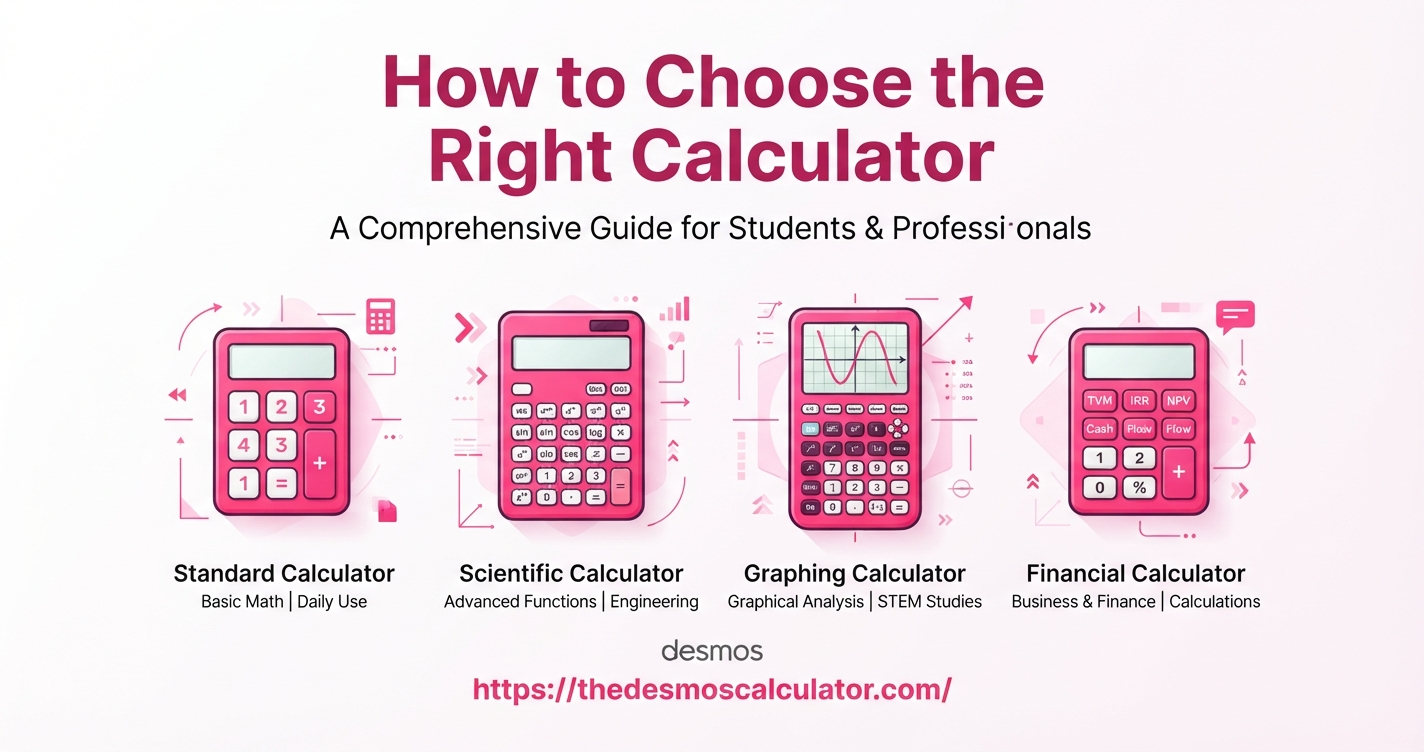
Choosing the right calculator can seem simple, but there are many different types of calculators available today. A basic calculator, scientific calculator, graphing calculator, financial calculator, and online calculator are designed for different jobs.
The best calculator is not always the most expensive or the one with the most buttons. The right choice depends on what you need to calculate, how often you use it, what features you need, and where you will use it.
For example, someone who only needs to add prices does not need a graphing calculator. A student studying algebra and trigonometry may need a scientific calculator. A person working with loans may need a financial calculator. Someone who wants to calculate percentages, age, BMI, mortgage payments, or square footage may find an online calculator easier and faster.
This guide explains how to choose the right calculator in simple English. It covers calculator types, important features, online calculators, school and work needs, accuracy, common mistakes, and questions to ask before choosing a calculator.
Quick Answer: How Do You Choose the Right Calculator?
Start by asking what you want the calculator to do.
If you only need addition, subtraction, multiplication, and division, a basic calculator is usually enough. If you need trigonometry, logarithms, fractions, powers, or statistics, a scientific calculator may be more suitable. If you need to see equations and functions as graphs, consider a graphing calculator. For loans, interest, investments, and other financial calculations, a financial calculator may be useful.
For many everyday questions, an online calculator can be the easiest option because you do not need to buy or carry a separate device.
The important rule is simple:
Choose the calculator based on the problem you need to solve, not simply on the number of features it has.
Why Choosing the Right Calculator Matters
Different calculations require different tools. Using the wrong calculator can make a simple task confusing or can force you to perform calculations manually that a suitable tool could complete quickly.
A calculator can also produce a result that looks correct even when the wrong inputs or formula have been used. This is why choosing the correct calculator is about more than finding a tool with a familiar name.
For example, a percentage calculator and a basic calculator can both perform percentage-related arithmetic, but a dedicated percentage calculator can make common percentage questions easier to understand.
The same idea applies to financial calculations. A mortgage calculator can organize information such as loan amount, interest rate, loan term, and estimated payment in a way that is easier to use than entering a long formula into a basic calculator.
Before using any calculator, ask:
- What am I trying to calculate?
- What information do I already have?
- What result do I need?
- Does the calculator support that type of calculation?
- Do I understand what the result means?
These questions can help you select the right tool before entering any numbers.
Understand the Main Types of Calculators
The first step is learning what the main calculator types are designed to do.
| Calculator Type | Common Uses | Typical Users |
|---|---|---|
| Basic Calculator | Addition, subtraction, multiplication, division | Everyday users |
| Scientific Calculator | Algebra, trigonometry, powers, roots, statistics | Students, science users |
| Graphing Calculator | Graphs, equations, functions, tables | Advanced students |
| Financial Calculator | Loans, interest, investments, payments | Business and finance users |
| Online Calculator | Specific calculations and quick answers | Anyone |
| Unit Converter | Length, weight, temperature, area, and more | Students, workers, everyday users |
| Health Calculator | BMI, calorie estimates, age and similar calculations | General users |
| Construction Calculator | Measurements, area, volume, and building calculations | Tradespeople |
The exact functions vary between models and websites. A scientific calculator, for example, can have different functions depending on the model. Official calculator guides commonly separate basic, scientific, and graphing calculators because they serve different levels of mathematical work.
Choose a Basic Calculator for Simple Math
A basic calculator is designed for everyday arithmetic.
It normally handles:
- Addition
- Subtraction
- Multiplication
- Division
- Percentages
- Decimal calculations
- Basic memory functions
- Sometimes square roots or tax and discount functions
If you are adding shopping costs, checking a bill, calculating a simple percentage, or doing household arithmetic, a basic calculator may be all you need.
There is no benefit in choosing a complicated calculator simply because it has more functions. More features can sometimes make a calculator harder to learn.
When Is a Basic Calculator Enough?
A basic calculator is usually suitable when your calculations look like:
25 + 18 = 43
or:
150 × 0.20 = 30
It can also be useful for quick office, home, retail, and everyday calculations.
If your work regularly involves algebra, trigonometry, logarithms, statistics, or scientific formulas, you may need something more advanced.
Choose a Scientific Calculator for Advanced Math
A scientific calculator is designed for more complex mathematical work.
Common scientific functions include:
- Fractions
- Powers and exponents
- Square roots
- Trigonometric functions
- Logarithms
- Factorials
- Scientific notation
- Statistical calculations
- Parentheses
- Memory functions
- Equation-related functions on some models
Scientific calculators are commonly used in mathematics and science education. Calculator selection guides also note that the exact features can vary between models, so students should check what their course or school requires.
For example, if you need to calculate:
sin(30°)
a scientific calculator is much more appropriate than a simple four-function calculator.
The same applies to calculations involving powers, roots, logarithms, and more complicated mathematical expressions.
Choose a Graphing Calculator for Graphs and Functions
A graphing calculator goes beyond calculating a numerical answer. It can display mathematical relationships visually.
Graphing calculators can be useful for:
- Plotting equations
- Studying functions
- Comparing graphs
- Finding intersections
- Working with tables
- Exploring mathematical relationships
- Advanced algebra
- Some statistics and scientific work
For example, instead of only calculating the value of:
y = x² + 1
a graphing calculator can show the shape of the function.
Graphing tools can therefore be useful when the visual relationship between numbers is important. Desmos, for example, documents graphing features that allow users to plot points, equations, and curves and identify points of interest.
Do You Need a Graphing Calculator?
Not everyone needs one.
If you only need numerical answers, a scientific calculator may be enough. If your course, job, or project requires graphing functions, then graphing capability becomes much more useful.
Before buying one for school, always check the rules of your class or examination. Some exams have specific calculator requirements or restrictions.
Choose a Financial Calculator for Money Calculations
Financial calculators are designed for calculations involving money over time.
They may be useful for:
- Loan payments
- Interest
- Annuities
- Investment calculations
- Cash flow
- Mortgage calculations
- Present value
- Future value
- Business calculations
A financial calculator can save time when you repeatedly work with financial formulas.
However, you do not always need a physical financial calculator. For a specific question, an online loan, mortgage, interest, or payment calculator may be easier.
The important point is to understand the assumptions behind the result. A financial calculator may produce a mathematical result based on the numbers entered, but real financial products can include fees, taxes, changing rates, penalties, or other terms.
For important financial decisions, use the calculator as a planning tool and check the actual terms from the relevant provider.
Online Calculators Can Be the Right Choice
Online calculators have become useful for many specific calculations because they can be accessed from a computer, tablet, or phone.
Instead of buying a separate calculator for every task, you can use a calculator designed for a particular question.
Examples include:
- Scientific Calculator
- Percentage Calculator
- Age Calculator
- BMI Calculator
- Mortgage Calculator
- Loan Calculator
- BMR Calculator
- Calorie Calculator
- Square Footage Calculator
- Length Converter
- Grade Calculator
The advantage is that each tool can focus on one calculation and explain the required inputs.
For example, if you want to know the percentage increase between two numbers, a dedicated percentage calculator can be easier to use than entering the formula manually.
How to Choose an Online Calculator
Not every online calculator is equally useful.
Before trusting an online calculator, look for these features:
1. Clear Input Fields
The calculator should clearly explain what each input means.
For example, a loan calculator should not simply show boxes labeled “A,” “B,” and “C.” It should explain whether the user needs to enter the loan amount, interest rate, or loan term.
2. Clear Results
The result should be easy to find and understand.
A good calculator should not hide the answer among unnecessary information.
3. Useful Explanations
A calculator becomes more helpful when it explains the formula, inputs, assumptions, or meaning of the result.
This is especially important for beginners.
4. Mobile-Friendly Design
Many people use calculators on phones. The interface should therefore work well on small screens.
Buttons should be large enough to tap, text should be readable, and users should not need to zoom in and out.
5. Correct Units
Pay attention to units.
For example:
- Inches vs. feet
- Pounds vs. kilograms
- Miles vs. kilometers
- Celsius vs. Fahrenheit
- Monthly vs. annual interest
A calculator can be mathematically correct while the final result is wrong because the input units were incorrect.
Match the Calculator to Your Purpose
One of the easiest ways to choose the right calculator is to start with your question.
| Your Question | Calculator to Consider |
|---|---|
| What is 25 × 48? | Basic Calculator |
| What is 15% of 800? | Percentage Calculator |
| What is my age? | Age Calculator |
| What is my BMI? | BMI Calculator |
| What will my mortgage payment be? | Mortgage Calculator |
| What will my loan payment be? | Loan Calculator |
| What grade do I need? | Grade Calculator |
| How many calories do I need? | Calorie/BMR Calculator |
| What is the area of my room? | Square Footage Calculator |
| How many centimeters are in 5 feet? | Length Converter |
| How do I solve trigonometric calculations? | Scientific Calculator |
| How do I graph an equation? | Graphing Calculator |
The goal is to choose the tool that directly matches the question.
Think About the Inputs Before Choosing
A calculator is only useful if you have the information it needs.
For example, a mortgage calculator may require:
- Home price
- Down payment
- Interest rate
- Loan term
A BMI calculator may require:
- Height
- Weight
A grade calculator may require:
- Current grades
- Assignment weights
- Target grade
- Remaining assessments
Before choosing a calculator, check its input requirements.
If you do not have the required information, the calculator may not be able to give you a meaningful result.
Check the Calculator’s Formula
The formula behind a calculator matters.
Two calculators can sometimes produce different results because they use different assumptions or methods.
For example, a financial calculator may calculate a fixed-rate payment while your real loan could have additional fees or a variable interest rate.
For academic calculations, your teacher or school may use a particular formula.
For this reason, do not choose a calculator only because it gives the answer you expected. Check whether the calculator uses the method appropriate for your situation.
A useful calculator should make its method or assumptions reasonably clear.
Check Units and Measurements
Unit errors are one of the easiest ways to get a wrong answer.
Suppose you are calculating the area of a room. Entering feet when the calculator expects meters can produce a completely different result.
Common units include:
- Inches
- Feet
- Yards
- Miles
- Millimeters
- Centimeters
- Meters
- Kilometers
- Ounces
- Pounds
- Grams
- Kilograms
- Celsius
- Fahrenheit
Always check the unit beside every input.
If you are using an online calculator, choose the correct unit before pressing the calculate button.
Accuracy and Rounding Matter
A calculator can display many decimal places, but that does not always mean the real-world answer is that precise.
For example, a result might be:
12.583746
But the information you entered may have been estimated.
In that situation, showing six decimal places can give a false impression of accuracy.
The correct number of decimal places depends on the problem.
For school mathematics, follow the rounding instructions given by your teacher or textbook. For measurements, consider the precision of the original measurement.
For financial calculations, rounding rules can also affect the final result, especially when payments are made over many periods.
Check the Input and Display Style
Some calculators allow you to enter a complete expression before calculating the answer.
For example:
(25 + 15) × 2
This can be easier to review than entering separate calculations one at a time.
Scientific calculators often provide more advanced expression entry and calculation history. Some online scientific calculators also support fractions, powers, trigonometry, and other advanced functions. Desmos, for example, documents scientific calculator features including basic operations, trigonometry, roots, fractions, exponents, statistics, and complex-number mode.
When choosing a calculator, think about how you prefer to enter calculations.
A clear display can help you spot mistakes before accepting the final answer.
Consider Ease of Use
A calculator with hundreds of functions is not automatically better for every user.
If you only need simple calculations, too many buttons may slow you down.
For students, a calculator should be easy to learn and suitable for the mathematics being studied.
For professionals, the best interface may depend on how often the calculator is used and how complex the calculations are.
When choosing an online calculator, look for:
- Simple navigation
- Clear labels
- Easy-to-read numbers
- Large buttons
- Responsive design
- Helpful instructions
- Fast loading
- Clear results
- No unnecessary steps
The goal is to make the calculation easier, not harder.
Think About School and Exam Rules
Students should check calculator rules before purchasing a calculator for school or an examination.
Different schools, teachers, courses, and examination systems may have different requirements.
A calculator that is useful for studying may not be permitted in a particular examination.
Before buying a calculator, check:
- Your school requirements.
- Your teacher’s instructions.
- Your examination board’s rules.
- The functions you are allowed to use.
- Whether graphing or programmable features are permitted.
Calculator guides also recommend checking examination requirements before choosing advanced models.
Consider Your Level of Math
Your academic level can help determine the right calculator.
| Level or Need | Possible Calculator |
|---|---|
| Everyday arithmetic | Basic Calculator |
| Early school math | Basic or suitable scientific calculator |
| Algebra | Scientific Calculator |
| Trigonometry | Scientific Calculator |
| Statistics | Scientific or advanced calculator |
| Advanced functions | Scientific or graphing calculator |
| Graphs and functions | Graphing Calculator |
| University STEM work | Scientific or graphing, depending on course |
| Finance and business | Financial Calculator |
| Quick everyday calculations | Online Calculator |
This is only a general guide. Course requirements should always come first.
Physical Calculator vs Online Calculator
Both physical and online calculators have advantages.
| Feature | Physical Calculator | Online Calculator |
|---|---|---|
| No internet needed | Yes | Usually no |
| Easy to carry | Usually | Phone or computer required |
| Specific calculation | Depends on model | Often easy to find |
| Dedicated buttons | Yes | Touch or keyboard |
| Specialized tools | Depends on device | Many options available |
| Easy to update | No | Website can update |
| Good for exams | Often | Depends on rules |
| Multiple calculator types | Requires multiple tools | Many tools can be available online |
A physical calculator can be useful when you need a dedicated device or when internet access is unavailable.
An online calculator can be convenient when you want a specific calculation without buying specialized hardware.
How to Choose a Calculator for Students
Students should begin by checking the requirements of their course.
Do not buy a calculator simply because another student has one.
Ask:
- What mathematics am I studying?
- Do I need trigonometry?
- Do I need statistics?
- Do I need fractions?
- Do I need equation solving?
- Do I need graphs?
- Is the calculator allowed in my exam?
- Will I use it for future courses?
For younger students, a simple calculator may be enough. As mathematics becomes more advanced, a scientific calculator may become useful.
For advanced mathematics, a graphing calculator may be required or recommended.
The right choice depends on the curriculum rather than the calculator’s marketing claims.
How to Choose a Calculator for Work
Work requirements can be very different from school requirements.
An office worker may need a basic calculator for prices, percentages, invoices, and totals.
An accountant may need more advanced financial functions.
An engineer may need scientific, engineering, or graphing functions.
A construction worker may need calculations involving measurements, areas, volumes, angles, or feet-and-inch values.
Ask yourself:
What calculation do I perform most often at work?
Then choose the tool that makes that calculation fast and easy.
How to Choose a Calculator for Home Use
Most households do not need an advanced physical calculator.
An online calculator can handle many common questions, such as:
- Household budgets
- Percentages
- Discounts
- Measurements
- Room area
- Age
- Unit conversion
- Loan estimates
- Mortgage estimates
- Simple math
For occasional calculations, using an online tool can be more practical than buying a specialized calculator.
How to Choose the Right Online Calculator for a Specific Problem
When searching online, use a specific description of your problem.
Instead of searching:
calculator
try searching:
percentage calculator
or:
mortgage payment calculator
or:
square footage calculator
or:
scientific calculator
Specific searches can help you find a tool designed for the calculation you actually need.
Once you open the calculator, check the inputs and instructions before entering your numbers.
Common Mistakes When Choosing a Calculator
Choosing the Most Advanced Calculator
More features do not always mean a better choice.
If you only need basic arithmetic, an advanced calculator may be unnecessary.
Choosing Based Only on Price
A cheap calculator may be enough for basic tasks, but price should not be the only factor.
Consider the functions, display, reliability, ease of use, and your actual requirements.
Ignoring School Rules
Students should never assume that an advanced calculator is automatically allowed in an exam.
Check the official rules first.
Ignoring Units
Always confirm whether the calculator expects feet, meters, kilograms, pounds, or another unit.
Entering the Wrong Numbers
Even the best calculator cannot correct incorrect input.
Check every number before trusting the result.
Assuming Every Calculator Uses the Same Formula
Different calculators may make different assumptions.
Read the calculator’s instructions when the result is important.
Trusting a Result Without Understanding It
A number is not automatically meaningful just because a calculator produced it.
Understand what the result represents.
A Simple Five-Step Calculator Selection Method
If you are still unsure which calculator to choose, use this five-step method.
Step 1: Identify the Question
Write down exactly what you want to know.
For example:
“What is 20% of $500?”
Step 2: Identify the Calculation
This is a percentage calculation.
Step 3: Choose the Matching Tool
A percentage calculator is designed for this type of question.
Step 4: Check the Inputs
Enter $500 as the original number and 20% as the percentage.
Step 5: Check the Result
The answer is $100.
This process works for many types of calculators.
Question → Calculation → Tool → Inputs → Result
Starting with the question rather than the calculator name is also recommended by calculator-selection guides because a calculator can be mathematically correct while still being the wrong tool for the actual problem.
Calculator Selection Checklist
Before choosing a calculator, use this checklist:
- I know what I need to calculate.
- I know which type of calculator matches my problem.
- I understand the required inputs.
- I checked the units.
- I checked the calculator’s functions.
- I understand the result.
- I checked school or exam rules if necessary.
- I considered whether an online calculator is easier.
- I checked the calculator’s assumptions.
- I know the result is an estimate if the inputs are estimates.
This simple checklist can prevent many common calculation mistakes.
Which Calculator Should You Choose?
There is no single calculator that is perfect for everyone.
The right choice depends on your needs.
If you need simple arithmetic, choose a basic calculator.
If you need advanced mathematical functions, choose a scientific calculator.
If you need to visualize equations and functions, choose a graphing calculator.
If you work with loans, interest, investments, or other financial calculations, consider a financial calculator.
If you need one specific calculation, an online calculator may be the easiest option.
The most important thing is to match the calculator to the job.
Why a Calculator’s Features Should Match Your Needs
A calculator should solve your problem without adding unnecessary complexity.
For example, someone calculating a shopping discount does not need graphing functions. A student studying trigonometry does not need to rely on a four-function calculator. A person calculating a mortgage payment may benefit from a tool that specifically handles loan inputs.
This is why choosing the right calculator starts with understanding your purpose.
A calculator is a tool. The goal is not to own the most advanced tool. The goal is to have the right tool for the calculation.
Frequently Asked Questions
What is the best calculator for everyday use?
A basic calculator is usually enough for simple arithmetic such as addition, subtraction, multiplication, division, and percentages. An online calculator can also be convenient for specific calculations.
What calculator should I use for algebra?
A scientific calculator is generally more suitable for algebra because it can handle functions such as powers, roots, fractions, and other mathematical expressions. The exact calculator required depends on your course.
Do I need a scientific calculator?
You may need a scientific calculator if your work includes trigonometry, logarithms, powers, roots, fractions, statistics, or other advanced mathematical functions. For simple arithmetic, a basic calculator is usually enough.
What is the difference between a scientific and graphing calculator?
A scientific calculator is mainly designed for advanced numerical calculations. A graphing calculator adds visual graphing capabilities and can display functions, equations, and other mathematical relationships.
Is an online calculator accurate?
An online calculator can provide accurate mathematical results when it uses an appropriate formula and the correct inputs. However, the result is only as useful as the information entered and the assumptions used by the calculator.
What should I check before using an online calculator?
Check the calculator’s purpose, input fields, units, formula or assumptions, and result format. Make sure the calculator matches the question you are trying to answer.
Can I use a phone instead of a calculator?
For many everyday calculations, a phone or online calculator can be convenient. However, students should check school and examination rules before using a phone or online calculator for academic work.
Should I buy a calculator with more functions?
Not necessarily. Choose functions that you actually need. A calculator with many unnecessary features can be harder to use and may cost more.
Which calculator is best for financial calculations?
A financial calculator or dedicated online financial calculator can be useful for loans, interest, mortgages, investments, and related calculations. Always check the assumptions and actual financial terms before making an important decision.
How do I know if a calculator is right for me?
Start with the calculation you need to perform. Then choose the calculator type that supports that calculation. Finally, check the inputs, functions, units, accuracy, and any relevant rules.
Final Thoughts
Choosing the right calculator does not have to be difficult.
The easiest method is to start with the question you want to answer. Once you understand the problem, you can choose the calculator that matches it.
A basic calculator is useful for everyday arithmetic. A scientific calculator is designed for more advanced mathematics. A graphing calculator is useful when you need to see equations and functions. Financial calculators help with specialized money calculations, while online calculators can provide convenient tools for specific problems.
Before using any calculator, check your inputs, units, formula, and assumptions. Remember that a calculator can process numbers correctly but still give an unhelpful answer if the wrong information or wrong method is used.
The best calculator is therefore not necessarily the most powerful one.
The right calculator is the one that matches your calculation, is easy for you to use, and gives you a result you can understand.
Find more useful calculators across different categories.
Explore More Calculators