Basic finance calculations help you understand what is happening with your money. You can use them to calculate interest on savings, estimate loan payments, measure profit, compare investments, work out percentages, and understand how money can grow over time.
You do not need to be a finance expert to understand these calculations. Most basic financial problems use a small group of formulas. Once you understand what each number means, you can calculate many everyday money questions with a calculator.
This guide explains the most useful basic finance calculations in simple English. It includes formulas, examples, tables, important points, and common mistakes to avoid.
Important: Financial calculations can provide estimates. Real loans, investments, bank accounts, taxes, and other financial products may include fees, taxes, changing rates, or other conditions that are not included in a basic formula.
What Are Basic Finance Calculations?
Basic finance calculations are mathematical methods used to understand money. They can help you answer questions such as:
- How much interest will I earn?
- How much interest will I pay?
- How much will my savings grow?
- What will my monthly loan payment be?
- What is my profit?
- What is my return on investment?
- How much will something cost after a percentage increase?
- What is the value of money in the future?
- How much money do I need to save for a goal?
Common financial formulas include simple interest, compound interest, loan payments, future value, present value, percentage change, profit, and return on investment.
Financial formula references commonly group these calculations around interest, time value of money, annuities, loans, and growth.
The important thing is not just knowing a formula. You should also understand what the result means.
For example, a loan calculator may tell you that a payment is $450 per month. That number alone does not tell you the complete cost of the loan. The interest rate, loan term, fees, taxes, and other charges can affect the actual amount you pay.
Why Are Finance Calculations Important?
Money changes over time. A small interest rate can make a difference when money is saved or borrowed for many years. The same is true for fees, investment returns, inflation, and loan costs.
Basic finance calculations give you a way to compare different situations before making a financial decision.
For example, suppose you are comparing two savings options. One account may have a higher interest rate, while another may compound interest more frequently. A calculation can help you understand how those differences affect the final amount.
Finance calculations are also useful for students, workers, families, business owners, homeowners, and anyone who wants to understand money better.
Common uses of financial calculations
| Calculation | What it helps you find |
|---|---|
| Simple interest | Interest based on the original amount |
| Compound interest | Growth including accumulated interest |
| Loan payment | Estimated regular loan payment |
| Future value | What money may become worth later |
| Present value | Today’s value of a future amount |
| ROI | Return compared with an investment cost |
| Profit | Money left after costs |
| Percentage change | Increase or decrease as a percentage |
| Savings growth | How savings may grow over time |
| CAGR | Average annual compound growth rate |
The Most Important Basic Finance Calculations
There are many financial formulas, but you can start with a smaller group of important calculations.
The following formulas cover many common personal finance and business questions.
1. Simple Interest Calculation
Simple interest is one of the easiest financial calculations.
It calculates interest using the original principal amount. The interest does not get added to the principal for calculating later interest periods.
The basic formula is:
Simple Interest = P × r × t
Where:
- P = principal or starting amount
- r = interest rate as a decimal
- t = time
If the rate is written as a percentage, divide it by 100 before using the formula.
Simple interest example
Suppose you deposit $2,000 at an annual interest rate of 5% for 3 years.
Convert 5% to a decimal:
5 ÷ 100 = 0.05
Now calculate:
Interest = $2,000 × 0.05 × 3
Interest = $300
The total amount becomes:
$2,000 + $300 = $2,300
Simple interest is also commonly explained as interest calculated only on the original principal.
Simple interest formula table
| Input | Example |
|---|---|
| Principal | $2,000 |
| Annual rate | 5% |
| Time | 3 years |
| Interest | $300 |
| Final amount | $2,300 |
Important point: Always check whether the financial product actually uses simple interest. Many savings and investment products use compounding instead.
2. Compound Interest Calculation
Compound interest is different because interest can be added to the balance and then earn additional interest.
This is often described as interest on interest.
The standard compound interest formula is:
A = P(1 + r/n)^(nt)
Where:
- A = final amount
- P = principal
- r = annual interest rate as a decimal
- n = number of compounding periods per year
- t = number of years
This standard formula is widely used in financial mathematics.
Compound interest example
Suppose you invest $5,000 at 6% annual interest, compounded annually, for 5 years.
The formula is:
A = 5,000(1 + 0.06/1)^(1×5)
The result is approximately:
$6,691.13
So the interest earned is approximately:
$6,691.13 − $5,000 = $1,691.13
The longer the money remains invested, the more important compounding can become.
Simple interest vs compound interest
| Feature | Simple Interest | Compound Interest |
|---|---|---|
| Starting amount | Used | Used |
| Previous interest included | No | Yes |
| Formula | P × r × t | P(1+r/n)^(nt) |
| Common use | Some basic loans and examples | Savings and investments |
| Growth over long periods | Linear | Can accelerate |
Neither calculation should automatically be assumed to apply to every financial product. Always check the terms of the account or loan.
3. Future Value Calculation
Future value helps answer:
“How much could this money be worth in the future?”
For a single amount with annual compounding, a basic formula is:
FV = PV(1 + r)^n
Where:
- FV = future value
- PV = present value
- r = interest rate per period
- n = number of periods
This is one of the basic time-value-of-money formulas.
Example
You have $3,000 today and assume it grows at 5% per year for 10 years.
FV = $3,000(1.05)^10
The future value is approximately:
$4,886.68
This is a mathematical estimate based on a constant 5% rate. Real investment returns may vary.
4. Present Value Calculation
Present value works in the opposite direction.
It asks:
“What is a future amount worth today?”
The basic formula is:
PV = FV / (1 + r)^n
Where:
- PV = present value
- FV = future value
- r = rate per period
- n = number of periods
Financial formula references use this relationship to discount a future amount back to its present value.
Example
Suppose you expect to receive $10,000 in 5 years and use a discount rate of 6%.
The calculation is:
PV = $10,000 / (1.06)^5
The present value is approximately:
$7,472.58
This does not mean that someone will necessarily pay you exactly $7,472.58 today. It is a mathematical present-value calculation based on the selected discount rate.
5. Loan Payment Calculation
Loan payments are another important part of basic finance calculations.
For a fixed-payment loan, the standard payment formula is:
PMT = P × r / [1 − (1+r)^−n]
Where:
- PMT = payment per period
- P = loan principal
- r = interest rate per payment period
- n = total number of payments
The rate and number of periods must match. For example, if payments are monthly, you normally use a monthly interest rate and the total number of monthly payments.
Example
Suppose you borrow:
- Loan = $20,000
- Annual interest rate = 6%
- Term = 5 years
- Payments = monthly
The monthly interest rate is:
6% ÷ 12 = 0.5%
The number of payments is:
5 × 12 = 60
Using the fixed-payment loan formula gives an estimated monthly payment of about:
$386.66
The total of 60 payments would be approximately:
$23,199.60
So the estimated interest over the loan term would be about:
$3,199.60
This example assumes a fixed rate and regular monthly payments and does not include possible fees, taxes, insurance, or other charges.
6. Percentage Calculation
Percentages are used throughout personal finance and business.
A basic percentage calculation is:
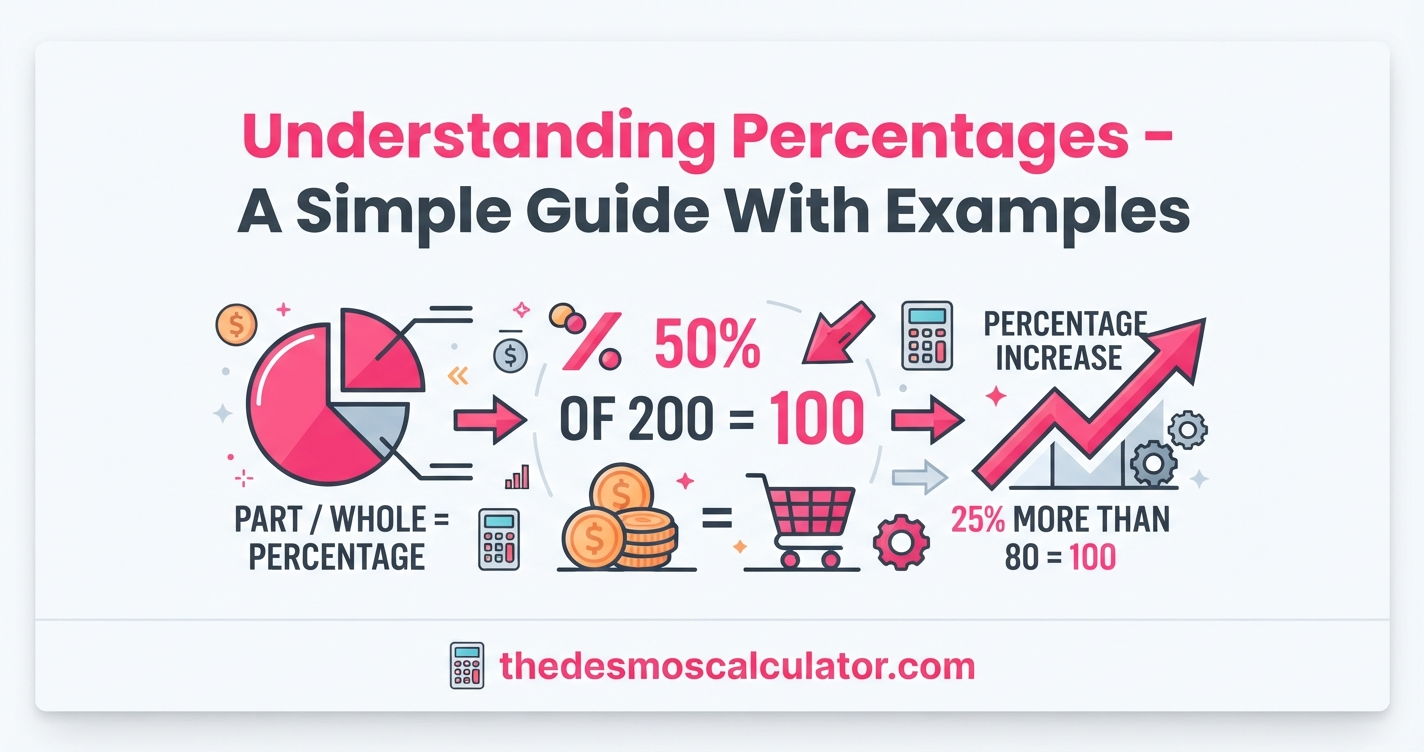
Percentage = Part ÷ Whole × 100
Example
If you save $200 from an income of $2,000:
$200 ÷ $2,000 × 100 = 10%
You saved 10% of the income.
Percentages are also useful for discounts, taxes, price changes, interest rates, profit margins, and investment returns.
Percentage increase
The formula is:
Percentage Increase = (New Value − Old Value) ÷ Old Value × 100
For example, if a product increases from $100 to $120:
($120 − $100) ÷ $100 × 100 = 20%
The price increased by 20%.
7. Profit Calculation
Profit is important for businesses and side projects.
A simple profit formula is:
Profit = Revenue − Total Costs
For example:
- Revenue = $8,000
- Total costs = $5,000
Therefore:
Profit = $8,000 − $5,000 = $3,000
Profit is not the same as revenue. Revenue is the money generated from sales, while profit is what remains after relevant costs are deducted.
Profit calculation table
| Item | Amount |
|---|---|
| Sales revenue | $8,000 |
| Total costs | $5,000 |
| Profit | $3,000 |
8. Return on Investment Calculation
Return on investment, commonly called ROI, compares the gain or loss from an investment with its cost.
A basic ROI formula is:
ROI = (Investment Gain − Investment Cost) ÷ Investment Cost × 100
For example, suppose an investment costs $5,000 and later has a value of $5,750.
The gain is:
$5,750 − $5,000 = $750
ROI is:
$750 ÷ $5,000 × 100 = 15%
So the basic ROI is 15%.
ROI is useful for comparing investments, but it does not by itself describe the time taken to earn the return. OpenStax also distinguishes basic ROI from measures that account for the investment period.
9. Savings Calculation
Savings calculations help you estimate how much money you may have after making regular deposits.
For example, if you save:
$300 per month
for:
12 months
without considering interest:
$300 × 12 = $3,600
So you would contribute $3,600 during the year.
If the account earns interest, the final balance can be different because the deposits may earn interest at different times.
For regular contributions combined with interest, an annuity or savings-growth formula may be more appropriate than simple multiplication. Financial formula references commonly provide future-value formulas for regular payments.
10. Rule of 72
The Rule of 72 is a quick estimation method for understanding how long it may take money to double at a constant annual rate.
A simple version is:
Years to Double ≈ 72 ÷ Interest Rate
For example, at an assumed annual rate of 8%:
72 ÷ 8 = 9 years
So the Rule of 72 gives an estimate of about 9 years.
It is only an approximation. It is not a replacement for a detailed compound-interest calculation.
11. CAGR Calculation
CAGR means Compound Annual Growth Rate.
It estimates the average annual compound growth rate between a beginning value and an ending value.
The formula is:
CAGR = (Ending Value ÷ Beginning Value)^(1/Years) − 1
This formula is commonly used to describe growth over multiple years.
Example
Suppose an amount grows from $10,000 to $15,000 over 5 years.
The CAGR is:
($15,000 ÷ $10,000)^(1/5) − 1
The result is approximately:
8.45%
This means the growth is equivalent to an approximately 8.45% annual compound growth rate over the five-year period.
CAGR is a mathematical description of growth. It does not mean the actual amount increased by exactly the same percentage every year.
Basic Finance Formulas at a Glance
| Calculation | Formula |
|---|---|
| Simple Interest | I = P × r × t |
| Compound Interest | A = P(1 + r/n)^(nt) |
| Future Value | FV = PV(1+r)^n |
| Present Value | PV = FV/(1+r)^n |
| Loan Payment | PMT = P×r/[1−(1+r)^−n] |
| Percentage | Part ÷ Whole × 100 |
| Profit | Revenue − Costs |
| ROI | (Gain − Cost) ÷ Cost × 100 |
| Percentage Change | (New − Old) ÷ Old × 100 |
| CAGR | (EV/BV)^(1/n) − 1 |
How to Choose the Right Finance Calculation
Choosing the correct formula is often more important than doing the arithmetic.
Start by asking what you want to know.
| Your question | Useful calculation |
|---|---|
| How much interest will I earn? | Simple or compound interest |
| How much will savings grow? | Future value |
| What is a future payment worth today? | Present value |
| What is my monthly loan payment? | Loan payment |
| How much did my investment return? | ROI |
| How quickly did something grow? | CAGR |
| How much money did my business make? | Profit |
| How much did a price change? | Percentage change |
| How much should I save each month? | Savings/annuity calculation |
| How long could money take to double? | Rule of 72 |
A good financial calculator should also make the inputs clear. Finance-calculator resources commonly separate the inputs, formula, worked example, and limitations so users can understand what the result represents.
Why the Time Period Matters
One of the most common mistakes in finance calculations is mixing different time periods.
Suppose a loan has an annual interest rate but payments are made monthly. You cannot simply use the annual rate as the monthly rate.
For a basic calculation:
Monthly rate = Annual rate ÷ 12
Likewise:
Number of monthly payments = Years × 12
For example, a 10-year loan with monthly payments has:
10 × 12 = 120 payments
When using a financial formula, the interest rate and number of periods should normally use the same period.
Example of matching periods
| Item | Annual | Monthly |
|---|---|---|
| Interest rate | 6% | 0.5% |
| Time | 5 years | 60 months |
| Payments | 1/year | 60 total |
This period matching is especially important for loan, savings, present-value, and future-value calculations.
Common Mistakes in Finance Calculations
Even a correct formula can produce a misleading answer if the inputs are wrong.
Using a percentage incorrectly
If the formula requires a decimal and you enter 5 instead of 0.05, the answer can be dramatically wrong.
5% = 0.05
Mixing years and months
A monthly interest rate should not be paired with a number of years without converting the periods.
Forgetting compounding
A compound-interest calculation can produce a different result from simple interest because accumulated interest can also earn interest.
Ignoring fees
A basic loan formula may calculate principal and interest but not include every fee or charge.
Assuming investment returns are guaranteed
A mathematical growth calculation may use a constant rate for illustration. Actual investment returns can change.
Rounding too early
If you round every intermediate result, the final answer can become less accurate. It is usually better to keep more decimal places during the calculation and round the final result.
How Online Finance Calculators Help
Online finance calculators can make financial calculations much easier.
Instead of entering a long formula manually, you can enter the values and let the calculator perform the mathematics.
A useful calculator should show more than just one number. It should clearly explain:
- What each input means
- What formula is being used
- The result
- The units or time period
- Important assumptions
- Any limitations
For example, a loan calculator can be used to estimate the monthly payment, total payments, and total interest. A compound-interest calculator can show how an amount may grow over time.
The best way to use a calculator is to understand the result rather than blindly accept it.
Basic Finance Calculations for Everyday Money
You can use these calculations for many everyday situations.
Saving money
Calculate how much you contribute each month and estimate how interest may affect the final balance.
Comparing loans
Compare monthly payments, total interest, loan terms, and other costs.
Understanding discounts
Calculate the percentage discount before buying an expensive product.
Measuring investment returns
Use ROI or growth calculations to understand how an investment changed in value.
Planning a financial goal
Work backward from a future target to estimate how much you may need to save.
Checking business profit
Compare revenue with costs to understand the basic profit from sales.
Example: Combining Several Finance Calculations
Suppose you start with $10,000 and invest it for five years at an assumed annual compound rate of 5%.
The future-value calculation is:
FV = $10,000(1.05)^5
The estimated final value is approximately:
$12,762.82
The estimated growth is:
$12,762.82 − $10,000 = $2,762.82
The percentage gain is:
$2,762.82 ÷ $10,000 × 100 = 27.63%
This simple example shows how different financial calculations can work together.
However, this is a mathematical example using a constant rate. Actual investment performance may be different.
Important Finance Terms to Know
Understanding a few basic terms makes finance calculations much easier.
| Term | Simple meaning |
|---|---|
| Principal | Original amount of money |
| Interest | Cost of borrowing or earnings on money |
| Rate | Percentage used in a calculation |
| Term | Length of time |
| Payment | Money paid at regular intervals |
| Future value | Value at a future date |
| Present value | Value expressed in today’s terms |
| Revenue | Money received from sales |
| Cost | Money spent |
| Profit | Revenue minus costs |
| ROI | Return compared with investment cost |
| Compounding | Earning or paying interest on accumulated amounts |
| Inflation | General increase in prices over time |
Important Points to Remember
Before using any finance formula, check these points:
- Know what you are trying to calculate.
- Use the correct formula.
- Convert percentages correctly.
- Keep the time periods consistent.
- Check whether interest is simple or compounded.
- Include relevant fees when comparing real financial products.
- Do not treat estimates as guarantees.
- Keep enough decimal places during calculations.
- Check your answer to make sure it makes sense.
- For important financial decisions, review the actual terms of the product or seek qualified professional advice.
Frequently Asked Questions About Basic Finance Calculations
What are basic finance calculations?
Basic finance calculations are mathematical methods used to understand money. Common examples include simple interest, compound interest, loan payments, future value, present value, profit, ROI, percentages, and savings growth.
What is the most basic financial formula?
One of the simplest financial formulas is the simple-interest formula:
I = P × r × t
It calculates interest using the principal, interest rate, and time.
What is the difference between simple and compound interest?
Simple interest is calculated using the original principal. Compound interest can include previously earned or charged interest in later calculations. This can make the results different, especially over longer periods.
How do I calculate a loan payment?
For a fixed-rate installment loan, a standard payment formula is:
PMT = P × r / [1 − (1+r)^−n]
The rate must match the payment period, and the total number of payments must be used.
What is ROI in finance?
ROI, or return on investment, compares the gain or loss from an investment with the amount invested. A basic formula is:
ROI = (Gain − Cost) ÷ Cost × 100
What is future value?
Future value estimates what an amount of money may become worth at a future date when a specified growth or interest rate is applied.
What is present value?
Present value estimates the value today of an amount that will be received or paid in the future, using a selected discount rate.
Can I use a calculator for basic finance calculations?
Yes. A finance calculator can make calculations faster and reduce arithmetic errors. However, you should still check the formula, inputs, assumptions, and terms behind the result.
Are finance calculator results always exact?
No. A calculator can produce an exact mathematical result based on the numbers and formula entered, but the real financial situation may include changing rates, fees, taxes, inflation, or other conditions.
Conclusion
Basic finance calculations are useful tools for understanding everyday money decisions. You can use simple formulas to calculate interest, estimate loan payments, understand savings growth, measure investment returns, calculate profit, and compare financial situations.
The most useful formulas to learn first are simple interest, compound interest, future value, present value, loan payment, percentage change, profit, ROI, and CAGR.
You do not need advanced financial knowledge to start. Learn what each input means, keep your time periods consistent, use the correct formula, and check the assumptions behind the result.
For faster calculations, an online finance calculator can handle the mathematics while allowing you to focus on understanding what the result means. Financial formula resources also emphasize checking the inputs, formula, worked example, and limitations rather than treating a calculator output as the complete answer.
Most importantly, remember that a mathematical estimate is not the same as a promise about future financial performance. Use calculations as a tool for understanding and planning, and check the actual terms of any financial product before making an important decision.
Explore More Calculators
Find more useful calculators across different categories.