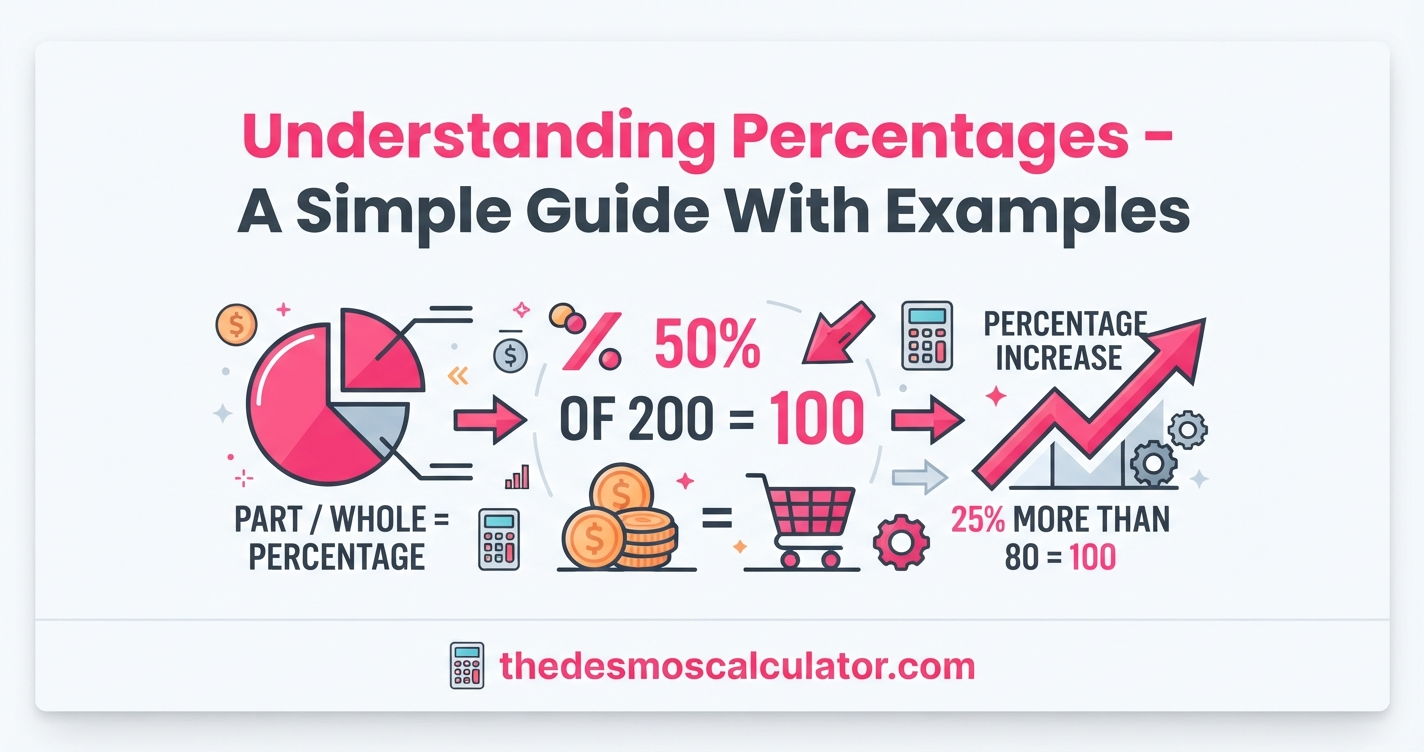
Percentages are one of the most useful parts of everyday mathematics. You see them when shopping, checking exam scores, comparing prices, reading statistics, calculating interest, looking at discounts, and understanding changes in numbers.
The good news is that percentages are not as difficult as they may seem. Once you understand that percent means “out of 100,” most percentage problems become much easier.
For example, 25% means 25 out of 100. It can also be written as 25/100, 0.25, or 1/4. These are different ways of showing the same value.
This guide explains percentages from the beginning. You will learn what a percentage means, how to calculate percentages, how to convert between percentages and decimals, how to find percentage increases and decreases, and how percentages are used in real life.
If you need a quick answer instead of working through the math yourself, you can also use a Percentage Calculator to calculate common percentage problems quickly and reduce calculation errors.
What Is a Percentage?
A percentage is a way of showing a number as a part of 100.
The word percent means “per hundred.” The percentage symbol is %.
For example:
- 10% means 10 out of 100.
- 25% means 25 out of 100.
- 50% means 50 out of 100.
- 75% means 75 out of 100.
- 100% means the complete amount.
You can think of a percentage as a whole divided into 100 equal parts. If you have 30 of those 100 parts, you have 30%.
For example, imagine a box containing 100 apples. If 20 apples are red, then 20% of the apples are red.
The basic idea is:
Percentage = parts out of 100
This simple idea is the foundation of almost every percentage calculation.
Why Are Percentages Important?
Percentages make it easier to compare numbers.
Imagine one student gets 45 marks out of 50 and another student gets 80 marks out of 100. Looking only at the marks does not make the comparison easy.
The first student’s percentage is:
45 ÷ 50 × 100 = 90%
The second student’s percentage is:
80 ÷ 100 × 100 = 80%
The percentage makes the comparison easier because both results are placed on the same scale of 100.
Percentages are used in many areas of life, including:
| Area | Example |
|---|---|
| Shopping | 30% discount |
| Education | 85% exam score |
| Finance | 5% interest rate |
| Business | 12% increase in sales |
| Statistics | 62% of people surveyed |
| Tax | 8% sales tax |
| Sports | 75% success rate |
| Health | 20% of a daily value |
| Personal finance | 10% savings rate |
| Technology | 80% battery remaining |
Understanding percentages therefore helps with both school mathematics and everyday decisions.
The Basic Percentage Formula
The most common percentage formula is:
Percentage = (Part ÷ Whole) × 100
For example, suppose you answered 18 questions correctly out of 20.
Here:
- Part = 18
- Whole = 20
So:
Percentage = (18 ÷ 20) × 100
Percentage = 90%
Therefore, you answered 90% of the questions correctly.
The important thing is to identify the part and the whole before starting the calculation.
The Three Main Types of Percentage Problems
Most basic percentage questions can be placed into three groups.
Finding What Percentage One Number Is of Another
This asks:
“18 is what percent of 24?”
Use:
Percentage = (Part ÷ Whole) × 100
So:
18 ÷ 24 × 100 = 75%
Therefore, 18 is 75% of 24.
Finding a Percentage of a Number
This asks:
“What is 20% of 150?”
Convert 20% to a decimal:
20 ÷ 100 = 0.20
Then multiply:
0.20 × 150 = 30
So, 20% of 150 is 30.
Finding the Original or Whole Number
This asks:
“30 is 20% of what number?”
Use:
Whole = Part ÷ Percentage
First convert 20% into a decimal:
20% = 0.20
Then:
30 ÷ 0.20 = 150
So, 30 is 20% of 150.
These three question types cover a large part of everyday percentage calculations.
How to Calculate a Percentage of a Number
To find a percentage of a number, first convert the percentage into a decimal.
For example:
Find 15% of 200.
Convert 15% to a decimal:
15 ÷ 100 = 0.15
Now multiply:
0.15 × 200 = 30
Therefore:
15% of 200 = 30
You can also use the fraction method:
15% = 15/100
Then:
15/100 × 200 = 30
Both methods give the same answer.
More Examples
| Question | Calculation | Answer |
|---|---|---|
| 10% of 80 | 0.10 × 80 | 8 |
| 20% of 150 | 0.20 × 150 | 30 |
| 25% of 200 | 0.25 × 200 | 50 |
| 40% of 90 | 0.40 × 90 | 36 |
| 75% of 120 | 0.75 × 120 | 90 |
The key rule is simple:
Convert the percentage to a decimal, then multiply it by the number.
How to Find What Percentage One Number Is of Another
Sometimes you know the part and the whole, but you need to find the percentage.
Use:
Percentage = (Part ÷ Whole) × 100
For example:
What percentage is 30 of 120?
Step 1:
30 ÷ 120 = 0.25
Step 2:
0.25 × 100 = 25%
Therefore:
30 is 25% of 120.
Another example:
What percentage is 45 of 60?
45 ÷ 60 = 0.75
0.75 × 100 = 75%
So, 45 is 75% of 60.
This formula is especially useful for test scores, survey results, business reports, and data comparisons.
How to Convert Percentages to Decimals
Converting a percentage to a decimal is easy.
Divide the percentage by 100.
You can also move the decimal point two places to the left.
Examples:
| Percentage | Decimal |
|---|---|
| 5% | 0.05 |
| 10% | 0.10 |
| 25% | 0.25 |
| 40% | 0.40 |
| 50% | 0.50 |
| 75% | 0.75 |
| 100% | 1.00 |
| 125% | 1.25 |
For example:
35% = 35 ÷ 100 = 0.35
Remember that a percentage greater than 100% becomes a decimal greater than 1.
For example:
150% = 1.5
This means 150% is one and a half times the original amount.
How to Convert Decimals to Percentages
To convert a decimal into a percentage, multiply by 100.
For example:
0.25 × 100 = 25%
Other examples include:
| Decimal | Percentage |
|---|---|
| 0.05 | 5% |
| 0.10 | 10% |
| 0.25 | 25% |
| 0.50 | 50% |
| 0.75 | 75% |
| 1.00 | 100% |
| 1.25 | 125% |
A useful shortcut is to move the decimal point two places to the right and add the percentage symbol.
How to Convert Percentages to Fractions
A percentage can be changed into a fraction by placing the number over 100.
For example:
25% = 25/100
Then simplify:
25/100 = 1/4
Therefore:
25% = 1/4
More examples:
| Percentage | Fraction |
|---|---|
| 10% | 1/10 |
| 20% | 1/5 |
| 25% | 1/4 |
| 50% | 1/2 |
| 75% | 3/4 |
| 100% | 1 |
Percentages, fractions, and decimals are simply different ways of representing the same quantity.
How to Convert Fractions to Percentages
To convert a fraction to a percentage, divide the numerator by the denominator and multiply the result by 100.
For example:
3/4
First divide:
3 ÷ 4 = 0.75
Then multiply by 100:
0.75 × 100 = 75%
Therefore:
3/4 = 75%
Another example:
2/5
2 ÷ 5 = 0.4
0.4 × 100 = 40%
Therefore:
2/5 = 40%
Percentage Increase
A percentage increase tells you how much a value has gone up compared with its original value.
The formula is:
Percentage Increase = ((New Value − Original Value) ÷ Original Value) × 100
For example, a product’s price increases from $80 to $100.
Step 1: Find the increase.
100 − 80 = 20
Step 2: Divide by the original value.
20 ÷ 80 = 0.25
Step 3: Multiply by 100.
0.25 × 100 = 25%
So, the price increased by 25%.
Important Rule for Percentage Increase
Always use the original value as the base when calculating a percentage increase.
This is one of the most important rules in percentage calculations.
Percentage Decrease
A percentage decrease tells you how much a value has fallen compared with its original value.
The formula is:
Percentage Decrease = ((Original Value − New Value) ÷ Original Value) × 100
For example, a jacket costs $120 and its price falls to $90.
Step 1:
120 − 90 = 30
Step 2:
30 ÷ 120 = 0.25
Step 3:
0.25 × 100 = 25%
Therefore, the price decreased by 25%.
Percentage Change
Percentage change is useful when comparing an old value with a new value.
For an increase:
Percentage Change = (Increase ÷ Original Value) × 100
For a decrease:
Percentage Change = (Decrease ÷ Original Value) × 100
For example, if monthly website visitors increase from 2,000 to 2,500:
Increase:
2,500 − 2,000 = 500
Percentage increase:
500 ÷ 2,000 × 100 = 25%
The website traffic increased by 25%.
Percentage Difference vs Percentage Change
These two terms are sometimes confused.
Percentage change compares a new value with an original value.
Percentage difference is generally used when comparing two values without treating either one as the original starting point.
The common formula for percentage difference is:
Percentage Difference = |A − B| ÷ ((A + B) ÷ 2) × 100
For example, compare 80 and 100.
Difference:
100 − 80 = 20
Average:
(80 + 100) ÷ 2 = 90
Percentage difference:
20 ÷ 90 × 100 = 22.22%
This is different from the 25% increase from 80 to 100 because the reference point is different.
How to Calculate a Discount
Percentages are commonly used when stores offer discounts.
Suppose a pair of shoes costs $100 and has a 20% discount.
First find the discount:
20% of $100 = $20
Then subtract the discount:
$100 − $20 = $80
The final price is $80.
Discount Formula
Discount Amount = Original Price × Discount Rate ÷ 100
Then:
Sale Price = Original Price − Discount Amount
Discount Example Table
| Original Price | Discount | Discount Amount | Final Price |
|---|---|---|---|
| $50 | 10% | $5 | $45 |
| $100 | 20% | $20 | $80 |
| $200 | 25% | $50 | $150 |
| $500 | 30% | $150 | $350 |
This method can also be used for online shopping, coupons, sales, and price comparisons.
How to Calculate Tax Using a Percentage
Percentages are also used to calculate taxes.
Suppose an item costs $200 and the tax rate is 8%.
Tax:
200 × 0.08 = $16
Total cost:
200 + 16 = $216
So the tax is $16 and the final price is $216.
The general formula is:
Tax = Original Price × Tax Rate ÷ 100
And:
Total = Original Price + Tax
Always check whether the stated price already includes tax before calculating an additional amount.
How to Calculate a Tip
A restaurant tip is another common percentage calculation.
Suppose your restaurant bill is $60 and you want to leave a 15% tip.
Tip:
60 × 0.15 = $9
Total:
60 + 9 = $69
So a 15% tip on a $60 bill is $9.
You can use the same method for any tip percentage.
Percentages in Test Scores
Percentages make it easy to understand test results.
Suppose a student gets 42 correct answers from 50 questions.
Use:
42 ÷ 50 × 100 = 84%
The student’s score is 84%.
If a test has 80 questions and a student gets 68 correct:
68 ÷ 80 × 100 = 85%
The percentage score is 85%.
This is why percentages are commonly used in schools and exams: they put different tests on a common scale.
Percentages in Business
Businesses use percentages to measure changes and performance.
For example, a company may compare sales from one month to another.
If sales rise from $20,000 to $24,000:
Increase:
$24,000 − $20,000 = $4,000
Percentage increase:
$4,000 ÷ $20,000 × 100 = 20%
The company can therefore say that sales increased by 20%.
Businesses also use percentages for profit margins, growth rates, discounts, conversion rates, expenses, and other measurements.
Percentages in Personal Finance
Percentages are important when managing money.
You may see percentages in:
- Interest rates
- Savings rates
- Credit costs
- Investment returns
- Discounts
- Taxes
- Budget categories
- Price increases
For example, if you save 10% of a $3,000 monthly income:
3,000 × 0.10 = $300
You would save $300.
The calculation itself is simple, but understanding what the percentage refers to is essential.
Common Percentage Values to Know
Some percentages are especially useful for quick mental calculations.
| Percentage | Equivalent Fraction | Decimal |
|---|---|---|
| 1% | 1/100 | 0.01 |
| 5% | 1/20 | 0.05 |
| 10% | 1/10 | 0.10 |
| 20% | 1/5 | 0.20 |
| 25% | 1/4 | 0.25 |
| 50% | 1/2 | 0.50 |
| 75% | 3/4 | 0.75 |
| 100% | 1 | 1.00 |
Knowing these values can make simple percentage problems much faster.
For example, to find 50% of 80, simply divide 80 by 2.
80 ÷ 2 = 40
To find 25% of 80, divide by 4.
80 ÷ 4 = 20
To find 10% of 80, divide by 10.
80 ÷ 10 = 8
Easy Mental Math Tricks for Percentages
You do not always need a calculator for simple percentages.
Finding 10%
To find 10%, divide the number by 10.
10% of 300 = 30
Finding 1%
To find 1%, divide by 100.
1% of 300 = 3
Finding 5%
Find 10% and divide it by 2.
5% of 300:
10% = 30
5% = 15
Finding 20%
Find 10% and double it.
20% of 300:
10% = 30
20% = 60
Finding 25%
Divide the number by 4.
25% of 200:
200 ÷ 4 = 50
Finding 50%
Divide the number by 2.
50% of 200:
200 ÷ 2 = 100
These shortcuts are useful when you need a quick estimate or simple calculation.
Can a Percentage Be Greater Than 100%?
Yes.
A percentage does not have to be between 0% and 100%.
For example:
150% = 1.5
This means 150% is one and a half times the original amount.
If a company’s sales increase from $100 to $250, the new value is 250% of the original value.
However, the increase is:
250 − 100 = 150
150 ÷ 100 × 100 = 150% increase
This distinction is important.
250% of the original value and a 150% increase are not the same statement.
Can Percentages Be Less Than 1%?
Yes.
Very small percentages are common in statistics, finance, science, and probability.
For example:
0.5% = 0.005
And:
0.1% = 0.001
A small percentage can still represent a large number when the whole amount is very large.
For example, 0.5% of 1,000,000 is:
1,000,000 × 0.005 = 5,000
This is why it is important to look at both the percentage and the total amount.
Percentage vs Percentage Points
Percentage and percentage points are not always the same thing.
Suppose a savings rate changes from 5% to 7%.
The change is:
7% − 5% = 2 percentage points
But the percentage increase is:
(7 − 5) ÷ 5 × 100 = 40%
So the rate increased by 2 percentage points, which represents a 40% relative increase.
This distinction is important when reading financial reports, statistics, surveys, and news.
Common Percentage Mistakes
Percentage problems are often easy once you identify the correct formula. Most mistakes happen because the wrong number is used as the base.
Using the New Value Instead of the Original Value
For percentage increase and decrease, the original value is normally the reference point.
Forgetting to Divide by 100
20% is not 20 when used as a decimal.
20% = 0.20
Mixing Up Part and Whole
In:
20 is what percent of 80?
20 is the part.
80 is the whole.
So:
20 ÷ 80 × 100 = 25%
Confusing Percentage Change With Percentage Points
A change from 10% to 15% is 5 percentage points, not a 5% relative increase.
Rounding Too Early
If a calculation produces several decimal places, rounding at the beginning can produce a slightly different final result.
When accuracy matters, keep more decimal places during the calculation and round at the end.
When Should You Use a Percentage Calculator?
A percentage calculator can save time when the calculation contains several steps or when you want to check your manual answer.
It can be particularly useful for:
- Percentage of a number
- Finding what percentage one number is of another
- Percentage increase
- Percentage decrease
- Discounts
- Tax calculations
- Comparing values
- Checking homework
- Business calculations
- Financial calculations
A calculator is not a replacement for understanding the formula. Instead, it is a useful way to check your work and reduce simple arithmetic mistakes.
For a quick calculation, enter the relevant values into a Percentage Calculator and then compare the result with your manual calculation.
A Simple Percentage Formula Cheat Sheet
Keep these formulas available when solving percentage problems.
| Problem | Formula |
|---|---|
| Find a percentage of a number | Percentage ÷ 100 × Number |
| Find what percentage one number is of another | Part ÷ Whole × 100 |
| Find the whole | Part ÷ Decimal Percentage |
| Percentage increase | Increase ÷ Original × 100 |
| Percentage decrease | Decrease ÷ Original × 100 |
| Discount amount | Original Price × Discount ÷ 100 |
| Tax amount | Price × Tax Rate ÷ 100 |
| Percentage difference | Difference ÷ Average × 100 |
The most important formula to remember is:
Percentage = (Part ÷ Whole) × 100
Once you understand that formula, many other percentage formulas become easier to understand.
Worked Percentage Examples
Here are several examples that bring the main ideas together.
Example 1: Find 30% of 250
Convert 30% to a decimal:
30 ÷ 100 = 0.30
Multiply:
0.30 × 250 = 75
Answer: 75
Example 2: 45 Is What Percentage of 90?
45 ÷ 90 × 100 = 50%
Answer: 50%
Example 3: Increase From 200 to 240
Increase:
240 − 200 = 40
Percentage increase:
40 ÷ 200 × 100 = 20%
Answer: 20% increase
Example 4: Decrease From 500 to 425
Decrease:
500 − 425 = 75
Percentage decrease:
75 ÷ 500 × 100 = 15%
Answer: 15% decrease
Example 5: Find a 25% Discount on $80
Discount:
80 × 0.25 = $20
Sale price:
80 − 20 = $60
Answer: $60
How to Check Whether Your Percentage Answer Makes Sense
A quick reasonableness check can catch many mistakes.
Suppose you calculate 20% of 100 and get 200.
That cannot be correct because 20% is less than 100%, so 20% of 100 must be less than 100.
The correct answer is:
20% × 100 = 20
Useful benchmark checks include:
- 50% is half.
- 25% is one quarter.
- 10% is one tenth.
- 100% is the whole.
- 200% is twice the original amount.
These simple comparisons can help you spot an incorrect answer before relying on it.
Percentages in Everyday Life
You probably use percentages more often than you realize.
When a store says an item is 40% off, you are using percentages.
When a school says a student scored 92%, you are using percentages.
When a bank shows an interest rate of 4%, you are using percentages.
When a report says that sales increased by 12%, you are using percentages.
When a phone battery shows 65%, you are looking at a percentage.
Percentages give us a simple language for describing parts, comparisons, and changes.
Frequently Asked Questions About Percentages
What does percentage mean?
Percentage means a number expressed out of 100. For example, 25% means 25 out of 100.
What is the basic percentage formula?
The basic formula is:
Percentage = (Part ÷ Whole) × 100
For example, 20 out of 50 is:
20 ÷ 50 × 100 = 40%
How do I calculate 20% of a number?
Convert 20% to a decimal and multiply by the number.
20% = 0.20.
For example:
0.20 × 150 = 30
Therefore, 20% of 150 is 30.
How do I calculate percentage increase?
Subtract the original value from the new value, divide the result by the original value, and multiply by 100.
Percentage Increase = ((New − Original) ÷ Original) × 100
How do I calculate percentage decrease?
Subtract the new value from the original value, divide by the original value, and multiply by 100.
Percentage Decrease = ((Original − New) ÷ Original) × 100
Is 50% the same as 0.5?
Yes.
50% = 50/100 = 0.5
It is also equal to 1/2.
Is 100% always the whole amount?
When the percentage refers to a specific whole, 100% represents that entire amount.
For example, 100% of 200 is 200.
Can a percentage be greater than 100%?
Yes. For example, 150% means 1.5 times the original amount. Percentages above 100% are common when describing growth or comparing quantities.
What is the difference between percentage and percentage points?
Percentage points describe the direct difference between two percentage values. A percentage change describes the relative change compared with a starting value.
Why should I use a percentage calculator?
A percentage calculator can quickly solve percentage problems and help you check manual calculations. It is especially useful when several steps are involved.
Conclusion
Understanding percentages becomes much easier when you remember one basic idea: a percentage means a part out of 100.
From this idea, you can understand the main percentage formulas. To find what percentage one number is of another, divide the part by the whole and multiply by 100. To find a percentage of a number, convert the percentage to a decimal and multiply it by the number.
Percentages are useful far beyond the classroom. They help you understand discounts, taxes, tips, test scores, business growth, financial rates, statistics, and everyday comparisons.
The most useful formulas to remember are:
Percentage = (Part ÷ Whole) × 100
Percentage Increase = (Increase ÷ Original) × 100
Percentage Decrease = (Decrease ÷ Original) × 100
If you are unsure about a calculation, work through the formula step by step or use a Percentage Calculator to check your answer.
With a little practice, percentages become a simple and practical math skill that you can use confidently in everyday life.
Explore More Calculators
Find more useful calculators across different categories.